
Not long ago, healthcare collaboration meant phone calls, fax machines, scattered emails, and manual follow-ups between doctors, labs, pharmacies, and hospitals. Critical decisions were often made with incomplete information, delayed updates, or fragmented patient histories. Today, that model is rapidly becoming obsolete.
Healthcare collaboration platforms are transforming how care teams communicate, coordinate, and deliver outcomes—shifting the system from isolated silos to connected digital ecosystems. Clinicians can now share insights in real time, pharmacies can coordinate inventory and prescriptions seamlessly, and healthcare organizations can align faster around patient needs.
Current Challenges in Healthcare Collaboration
Fragmented Communication Across Stakeholders
Healthcare remains one of the most complex, multi-stakeholder industries. Physicians, nurses, pharmacists, diagnostic labs, insurers, and pharma companies often operate on separate systems with limited visibility into one another’s workflows.
This fragmentation leads to real-world problems:
- Duplicate diagnostics due to lack of shared reports
- Delayed treatment adjustments when feedback loops are slow
- Miscommunication between care settings during referrals or discharge
Without structured collaboration platforms, coordination depends heavily on manual processes that are inefficient and error-prone.
Data Silos and Poor Interoperability
Most healthcare organizations still rely on legacy systems that were never designed to communicate seamlessly. Electronic health records (EHRs), lab systems, pharmacy software, and hospital information systems often use incompatible formats.
The result is data silos—valuable clinical information trapped within individual systems. This slows care coordination, limits population-level insights, and increases administrative burden. Connected digital platforms are emerging as the bridge that links these disparate systems into a usable, shared ecosystem.
Increasing Demand for Integrated Care
Patients today expect continuity of care across providers and settings. Healthcare teams need unified access to patient histories, diagnostic results, medication data, and clinical insights—especially for chronic disease management and preventive care.
Technological Trends Driving Collaboration Platforms in 2026
A. AI and Automation
AI-Driven Clinical and Administrative Workflows
By 2026, AI is no longer experimental—it is embedded in daily healthcare operations. Collaboration platforms increasingly automate routine tasks such as documentation, appointment scheduling, referral routing, and clinical triage.
This automation reduces clinician burnout and frees healthcare professionals to focus on high-value patient interactions rather than administrative overhead.
Predictive Analytics for Care Coordination
Advanced analytics models help forecast patient risk, identify care gaps, predict hospital bottlenecks, and optimize care pathways. When embedded into collaboration platforms, these insights enable proactive coordination across teams rather than reactive decision-making.
B. Hybrid and Remote Care Models
Telehealth and RPM Integration
Virtual care is no longer a standalone channel. By 2026, telehealth and remote patient monitoring (RPM) are deeply integrated into collaboration platforms, enabling seamless coordination between in-clinic, virtual, and home-based care.
Wearables and IoMT Data Sharing
Wearables and Internet of Medical Things (IoMT) devices continuously generate real-time patient data. Collaboration platforms aggregate this information, allowing clinicians to make informed decisions remotely and coordinate interventions early.
C. Interoperability and Data Sharing Standards
Mandatory Data Exchange Protocols
Global adoption of standards like FHIR and open APIs is accelerating. Regulators and payers increasingly mandate data portability, making interoperability a requirement rather than an option.
Healthcare collaboration platforms serve as the operational layer that makes these standards usable in day-to-day clinical workflows.
Real-World Impact: Healthcare Outcomes and Systemic Efficiency
Improved Patient Outcomes Through Coordinated Care
When care teams share timely, accurate information, treatment decisions improve. Coordinated care reduces medication errors, avoids conflicting treatments, and ensures continuity across providers.
Reduced Redundancies and Efficiency Gains
Connected platforms help eliminate unnecessary diagnostic tests, streamline referrals, and shorten decision cycles—saving both time and cost for healthcare systems.
Enhanced Professional Development & Knowledge Exchange
Continuous education becomes embedded in daily workflows through platform-driven seminars, case discussions, and peer learning communities.
Conclusion
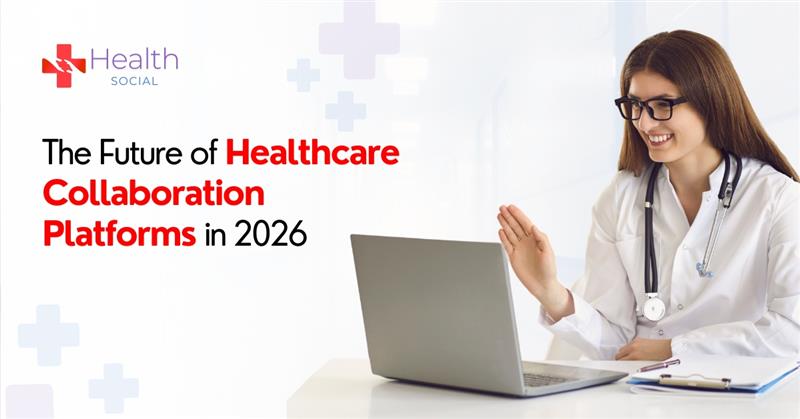
Healthcare collaboration platforms are no longer optional tools—they are foundational infrastructure for coordinated, efficient, and patient-centric care in 2026. As healthcare grows more complex, connected platforms enable stakeholders to move faster, collaborate better, and deliver safer outcomes.
The future of healthcare collaboration is not about replacing human expertise, but amplifying it through connected systems. Platforms like Health Social represent this evolution—bringing stakeholders together with secure communication, shared insights, and real-world impact.